🇵🇰🇮🇳 Pakistan & India: desperate times call for desperate measures?
Short circuits | June 30-July 27, 2026

Latest internet restrictions
Azad Jammu and Kashmir 🇵🇰 In July, residents of the Pakistan-administered province continued to face severe internet disruptions, which also sparked protests across the province.
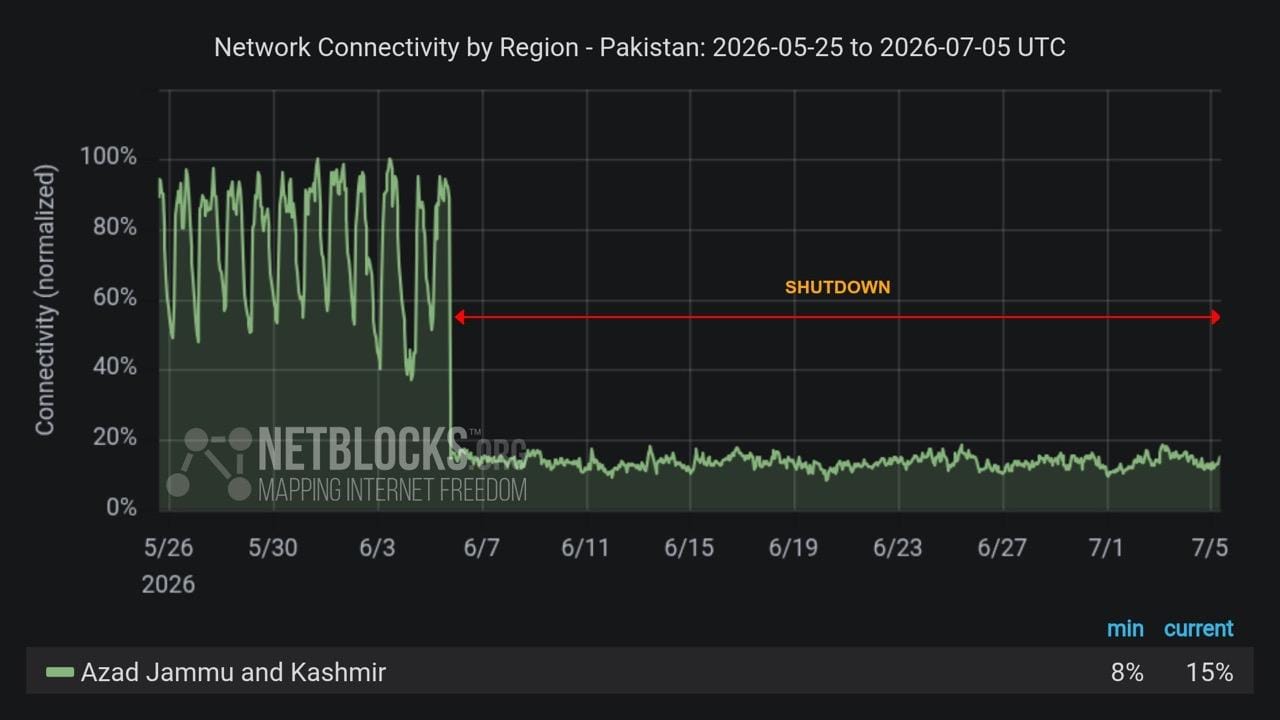
Meanwhile, the High Court of Azad Jammu and Kashmir has issued notices to four authorities regarding the ongoing suspension of internet services in the region. This action follows a constitutional petition that deemed the shutdown unlawful.
The province has seen weeks of strikes, sit-ins and clashes, resulting in dozens of deaths, both of protesters and law enforcement officers, ahead of the phased legislative assembly election, which is scheduled to begin on July 27.
India 🇮🇳 The country witnessed a coordinated crackdown on dissent through internet shutdowns targeting student protests. The crisis began on July 20 when mobile internet was suspended across central Delhi during the 'Chalo Sansad' protest, with telecom companies confirming government orders, The Wire reported.
The repression intensified between July 22 and 24 as authorities cut connectivity at Jantar Mantar and Mandi House during demonstrations led by activists, while also pressuring GitHub to remove Bitchat, a Bluetooth-based chat app, over dubious security concerns.
The crisis peaked on July 26 when Delhi experienced its longest internet shutdown during student protests, as reported by The Hindustan Times.
Want to know more? Read Amber Sinha’s analysis on Tech Policy Press, "India's CJP Protests Meet Internet Shutdowns and Pervasive Surveillance."
Tibet 🇨🇳 Beijing has launched a new three-month online campaign under the Central Cyberspace Affairs Commission’s "Qinglang" ("Clean Up") initiative. Officially framed as an effort to curb online fraud, impersonation, and misinformation, the campaign targets account names, identity disguises, and prohibited content across Chinese social media.
However, advocacy groups including the International Campaign for Tibet warn that the crackdown serves a dual purpose. Under the guise of digital safety, authorities are further tightening control over public narratives, heightening censorship around Tibetan-language posts, cultural content, and religious references, while further marginalising dissenting voices in the region.
The NGO also fears that the restrictive online environment for Tibetan linguistic and cultural expression could become even more prohibitive with China’s July 1 implementation of the Ethnic Unity and Progress Law. The legislation codifies state-directed integration policies, mandates standard Mandarin education and asserts extraterritorial legal jurisdiction over overseas critics.
Kazakhstan 🇰🇿 Some versions of the Radio Free Europe/Radio Liberty website have been inaccessible in the country over the past few weeks, warned the news radio network.
This is following an investigation published by Radio Azattyq, the local Kazakh service of RFE/RL, published an investigation pointing out links between family members of president Qasym-Zhomart Toqaev and VD Stroy-Engineering, a private company that receives large state contracts. The websites of the local radio, Radio Azattyq and Azattyq Asia, also suffered a denial-of-service attack on May
While two ministers issued a joint response on June 3 stating that they had not taken any measures against Radio Azattyq and Azattyq Asia, OONI observed a "persistent anomaly" for the domains of azattyq.org and azattyqasia.org that cannot be attributed to technical failure.
Russia 🇷🇺 Recent reports highlight a new wave of internet restrictions across Russia as state authorities tighten control over online communication. As reported by Ukrainska Pravda, Russian authorities instituted widespread mobile internet shutdowns in St. Petersburg and the surrounding Leningrad Oblast, restricting user access through strict, state-approved "whitelists."
In an effort to close remaining loopholes, Russian regulatory and intelligence agencies also moved to restrict foreign SIM cards and roaming traffic. By subjecting roaming networks to deep packet inspection (DPI) filtering, officials effectively blocked citizens from using foreign SIMs to bypass domestic censorship and VPN restrictions.
In compiling these reports, Ukrainska Pravda shared news and data gathered from other media outlets, including Russian outlets such as Fontanka, The Moscow Times, and Izvestia. While Russian ministries and local officials have publicly justified the internet blackouts and SIM card clampdowns as national security measures needed to counter Ukrainian drone operations, observers note that these tactics double as a broader strategy to curb independent information access and stifle potential social coordination.
Want to know more? Read Maria Kolomychenko’s analysis on Carnegie Endowment, "Kremlin Struggles to Solve a VPN Problem of Its Own Making," and Andrei Soldatov and Irina Borogan’s analysis on CEPA, "Kremlin Throttles the Internet."
🌍 Stay up to date with the latest internet disruptions with Internet Society’s Pulse shutdown tracker.
In this week's digital censorship news
🇹🇼 As part of its civil defense and ‘Han Kuang’ military exercises, Taiwan will test throttling 4G and 5G mobile data speeds down to approximately 1% of normal capacity across 14 cities and counties. The exercise aims to evaluate public communication resilience during severe network disruptions caused by potential conflict or natural disasters. Heise, July 24, 2026 / The Record, July 21, 2026
⚙️ Digital rights non-profit Unredacted released FreeSocks v2, a redesigned open-source VPN tool utilizing Xray proxy protocols and post-quantum encryption. The tool is specifically engineered to defeat deep packet inspection (DPI) and punch holes through severe state-level internet censorship. TechRadar, July 20, 2026
🔎 CNET published an analysis detailing the privacy and security limitations of VPNs. While VPNs encrypt connections and mask IP addresses, they do not offer complete anonymity, nor do they protect against phishing, tracking via logged-in accounts, or malware infections. CNET, July 11, 2026
🇮🇶 A study by Internet Society Pulse revealed that unstandardised internet censorship in Iraq - especially IP-level blocking - is causing significant collateral damage by accidentally restricting access to legitimate educational, business, and public service resources. Internet Society Pulse, July 9, 2026
🇮🇳 India is planning tighter regulatory measures for VPN providers. Authorities expressed growing concern over users employing encryption tools to bypass government-ordered content blocks and restricted applications. TechRadar, July 3, 2026
🇮🇩 Indonesia restored access to Reddit after an 11-year block. The Ministry of Communication and Digital Affairs approved the unblocking after Reddit complied with local regulatory requirements, including implementing geoblocking and removing illegal content. Jakarta Globe, July 3, 2026
🇮🇳 Cyber threat intelligence firm StealthMole published an investigation into an underground Telegram network involved in leaking national medical entrance exam (NEET) papers in India, detailing how illicit networks exploit messaging platforms for data trade and fraud. StealthMole, July 3, 2026
🛡️ French civil society organisation Nothing2Hide has launched Tech4Society, a free platform offering innovative and secure digital tools designed to strengthen the technical protection and security of journalists and human rights defenders facing online threats. Nothing2Hide, July 2, 2026
🇰🇪 In Kenya, the Ministry of Information, Communications and the Digital Economy and the Communications Authority published the Consumer Protection Regulations 2026. Replacing the 2010 framework, the new rules mandate outage compensation credits for subscribers, increase billing transparency, enforce data privacy standards, and require service providers to block harmful content and offer parental controls. Techweez, July 1, 2026
⚖️ In Doe v. Cisco, the US Supreme Court severely restricted legal remedies under the Alien Tort Statute and Torture Victim Protection Act. The ruling makes it significantly harder for victims to hold US technology companies accountable in American courts for supplying surveillance technologies used by foreign regimes in human rights abuses. Tech Policy Press, July 1, 2026
🙅 The Re:Create Coalition, a US-based an advocacy group that promotes balanced copyright laws and pro-consumer policies, warned against legislative pushes for site-blocking, emphasizing that forcing internet service providers to block websites causes widespread overblocking of lawful content, undermines free speech, and fails to stop online piracy. Re:Create Coalition, early July 2026
Upcoming events
🗓️ RightsCon Continues, September 22, 2026
Host: : Access Now
Website | Subscribe to the RightsCon Rundown
🗓️ Forum on Internet Freedom in Africa 2026 (FIFAfrica26), Mauritius, September 28-October 1, 2026
Host : Collaboration on International ICT Policy For East And Southern Africa (CIPESA)
Website | Register
